
Why You Need Tailscale

Why you need tailscale for anytime remote home access.

And Why I Only Install It on My Plex Server

Why you need Tailscale becomes obvious the moment you want secure, reliable access to your home network from anywhere without opening ports or exposing services to the internet. This post explains why you need Tailscale, and why I intentionally treat my Plex server as the only entry point into my network.
Read more

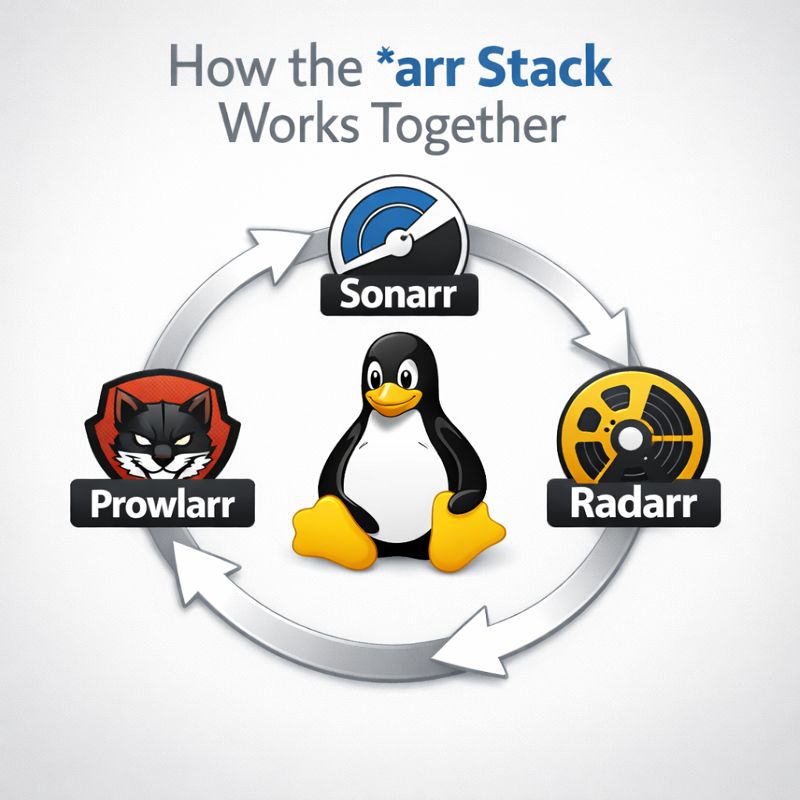
How Sonarr, Radarr, and Prowlarr Work Together

Sonarr, Radarr, and Prowlarr logos arranged in a circular workflow with arrows, surrounding a Linux penguin in the center, showing how the arr stack works together on Linux systems.

If you’re running a self-hosted media setup, Sonarr, Radarr, and Prowlarr are usually mentioned together — but it’s not always obvious why. They aren’t redundant, and they don’t do the same job. Each one handles a specific part of the pipeline, and when wired correctly, the whole system mostly runs itself.

Read more

A Beginner’s Guide to Linux

A man looking at the Linux penguin mascot while asking “What is Linux?” as an introduction to Linux for beginners

From a Windows User’s Perspective

I avoided Linux for years. Not because it was bad, but because it felt unnecessary. Windows worked, things mostly ran, and when they didn’t, I rebooted and moved on. Linux entered my life out of necessity: Raspberry Pis, servers, Docker, Plex, and eventually anything I didn’t want Windows touching.

This post is a practical, beginner-friendly overview of Linux. No distro wars, no gatekeeping. Just enough to understand what Linux is, how it’s different from Windows, and how to not feel lost the first time you open a terminal.

Read more