
Nvidia Acquiring Groq Through HALO?

Nvidia acquiring Groq illustrated by a dimly lit Groq office building beside a brightly lit Nvidia office building at night

A Hire and License Strategy Explained The idea of Nvidia acquiring Groq has gained traction not because of a traditional acquisition announcement, but because of how the deal has been described publicly. Recent reporting suggests Nvidia is not buying Groq outright, but instead absorbing critical assets in a way that achieves the same competitive outcome. … Read more

Why Nvidia Wants Out of the GPU Game

Why Nvidia wants out of the GPU game shown by a comparison between Nvidia gaming GPUs and AI data center accelerators

I have been thinking about this a lot lately, especially while watching GPU prices, availability, and where NVIDIA seems to be spending its energy. Why Nvidia wants out of the GPU game becomes obvious once you look at margins, fabrication limits, and where real growth exists. The short version is simple: if I were NVIDIA, I would rather sell one AI accelerator than thirty gaming GPUs. The longer version is what this post is about.

This is not about hating gamers or abandoning PC gaming entirely. It is about incentives, margins, and which market actually makes sense to prioritize.

This article explains why Nvidia wants out of the GPU game and why prioritizing AI accelerators makes more sense than focusing on the gaming market.


Read more

Why You Need Tailscale

Why you need tailscale for anytime remote home access.

And Why I Only Install It on My Plex Server

Why you need Tailscale becomes obvious the moment you want secure, reliable access to your home network from anywhere without opening ports or exposing services to the internet. This post explains why you need Tailscale, and why I intentionally treat my Plex server as the only entry point into my network.

Read more

Securing the Torrent Box

A Linux torrent box secured with a VPN, showing qBittorrent running only through an encrypted VPN connection for safe torrenting

This post covers how I secure my torrent box so it only runs torrents when the VPN is active. No firewall killswitch, no Docker, no pretending it’s more complicated than it is.

The goal is simple:

  • The VPN must be up before qBittorrent starts
  • If the VPN drops, qBittorrent must stop
  • qBittorrent should bind to the VPN interface/IP
  • PIA port forwarding should be applied automatically
  • Downloads should land on the drive with the most free space (for now)

This is a service-level enforcement model using systemd:

  • qbittorrent-vpn.service requires pia-vpn.service
  • If the PIA manual connection drops, the VPN service ends
  • When the VPN service ends, systemd stops qBittorrent immediately

Read more

Securing Your Indexers

Linux penguin protected by a shield and lock symbol representing securing your indexers with an always-on VPN for Prowlarr, Sonarr, and Radarr on Linux

Always-On VPN with Custom systemd Scripts

This post documents how I believe you should be securing your indexers; primarily Prowlarr, Sonarr and Radarr, along with the automation services that depend on it behind an always-on VPN using custom systemd scripts.

These services do not download torrents themselves, but they make constant outbound requests to indexers and third-party APIs. I don’t want that traffic coming directly from my home IP.

The goal is simple and strict: if the VPN isn’t up, the indexers should not be running.

Read more

How Sonarr, Radarr, and Prowlarr Work Together

Sonarr, Radarr, and Prowlarr logos arranged in a circular workflow with arrows, surrounding a Linux penguin in the center, showing how the arr stack works together on Linux systems.

If you’re running a self-hosted media setup, Sonarr, Radarr, and Prowlarr are usually mentioned together — but it’s not always obvious why. They aren’t redundant, and they don’t do the same job. Each one handles a specific part of the pipeline, and when wired correctly, the whole system mostly runs itself.

Read more

How to Install Sonarr on Raspbian

Sonarr logo next to the Linux penguin holding the Raspbian raspberry, representing installing Sonarr on Raspbian using Docker on a Raspberry Pi

Why the Old Methods Fail

If you search for “install Sonarr on Linux,” you’ll find plenty of guides telling you to add a repo, install Mono, and call it a day. On Raspbian, that advice is outdated and mostly broken.

I hit this wall myself. The traditional Sonarr install steps that work on Ubuntu or Debian-based servers either fail outright or leave you with a non-functional service on Raspberry Pi. This article documents what actually works on Raspbian today.

Read more

How to Install Sonarr

Sonarr logo with Linux penguin representing installing Sonarr on a Linux based system

On a Linux-Based System

Sonarr is one of those tools that feels optional until you use it for a week—then you wonder how you ever managed TV shows manually. This post walks through installing Sonarr on a Linux-based system, assuming you already have basic Linux access and aren’t afraid of the terminal.

If Linux still feels unfamiliar, I strongly recommend reading A Beginner’s Guide to Linux first. It explains distributions, package managers, and basic commands used throughout this guide.

Read more

How to Install Radarr

Linux penguin sitting in front of a terminal with the Radarr logo, representing installing Radarr on a Linux system

On a Linux-Based System

Radarr is one of those tools that quietly becomes critical once you start using it. It handles movie monitoring, quality upgrades, and automation, and it does it well. In this post, I’ll walk through how I install Radarr on a Linux-based system using the official repository.

If you’re brand new to Linux concepts like package managers, services, or the terminal, I strongly recommend starting withA Beginner’s Guide to Linux before continuing.

Read more

How to Install Prowlarr

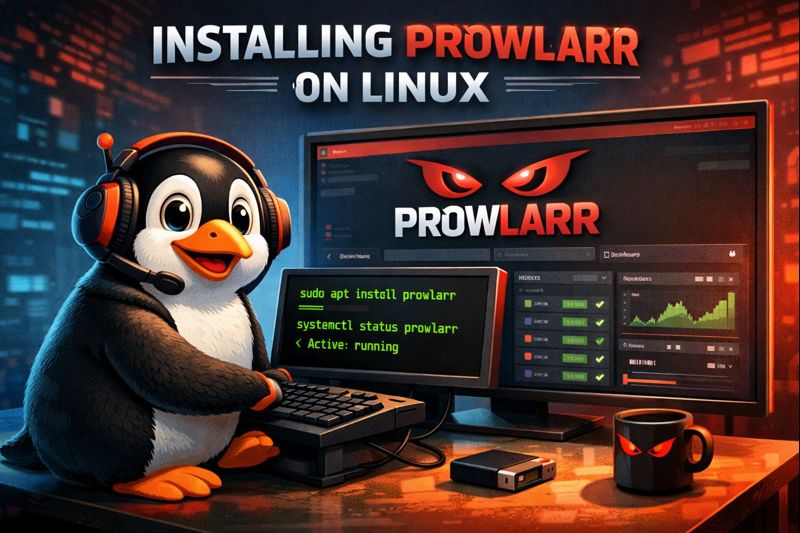
Linux penguin using a terminal to install Prowlarr, with the Prowlarr web interface displayed on screen

On a Linux-Based System

If you’re running a media automation stack on Linux, Prowlarr is one of those tools that quietly makes everything else less painful. It centralizes indexer management for Sonarr, Radarr, Lidarr, and friends, so you’re not reconfiguring the same indexers over and over again.

This post walks through how I install Prowlarr on a Linux-based system using the official method. I’m assuming you already have a basic Linux install up and running. If not, start with A Beginner’s Guide to Linux before continuing.

Read more